

Heavy snow accumulation is more than a seasonal nuisance for commercial buildings – it’s a structural, drainage, and liability risk. In Toronto, the GTA, and across Southern Ontario, flat and low-slope roofs are especially vulnerable during winter due to snow build-up, freeze-thaw cycles, and blocked drainage systems.
Whether you manage an industrial facility, office building, retail plaza, warehouse, or multi-residential property, understanding when snow becomes a problem – and how it should be addressed – is critical to protecting your roof and your building
Table Of Contents:
24/7 Snow Removals for Flat Roofs
Do You Always Need to Remove Snow from a Flat Roof?
Warning Signs Of Excessive Snow Build-Up
How To Remove Snow From Flat Roofs
Why Choose a Professional Roofer for Snow Removal?
What Does “Flat Roof Snow Load” Mean?
How Much Does Snow Weigh?
How Often Do Roofs Collapse from Snow Weight?
How To Plan for Winter Roof Safety
Quick Answer: Do Commercial Flat Roofs Need Snow Removal?
Yes- but only when conditions warrant it, and only by professionals.
A well-designed and properly maintained flat roof can safely support snow up to its engineered load capacity. However, snow should be professionally removed when accumulation becomes excessive, uneven, wet, or begins to interfere with drainage, rooftop systems, or structural performance.
Snow removal should never be handled by property staff or general snow contractors, it requires commercial roofing expertise and safety compliance.
24/7 Snow Removals for Flat Roofs
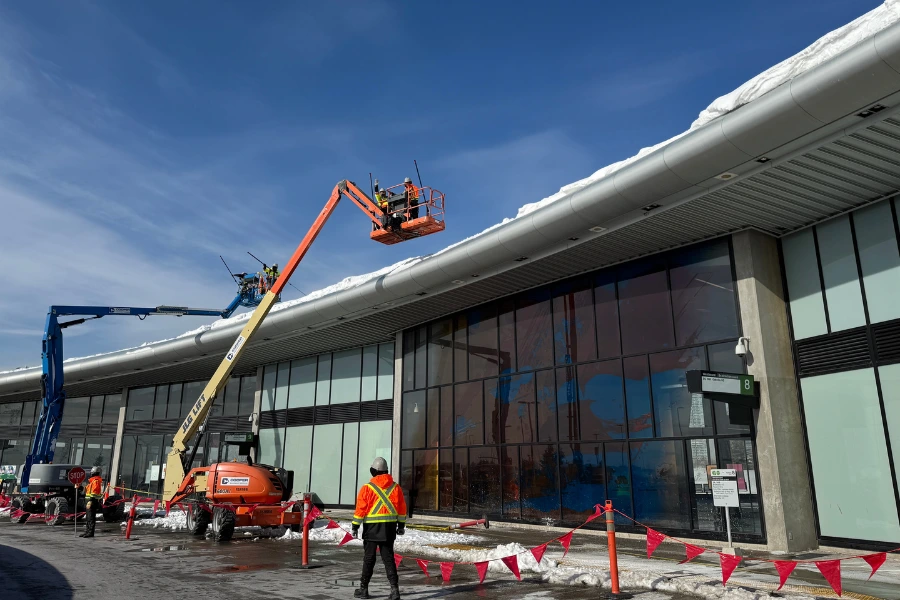
At Industrial Roofing Services Limited, we provide professional commercial roof snow removal services throughout Toronto, the GTA, and Southern Ontario – including 24/7 emergency flat roof repairs during severe winter conditions.
Our approach is not about clearing every inch of snow. It’s about strategic, controlled removal that:
- Reduces the risk of structural stress and overloading from excessive snow accumulation
- Protects roofing membranes and flashing
- Supports proper roof drainage by keeping scuppers and drains clear
- Reduces the risk of leaks and helps prevent water overload
- Focuses on removals around HVAC units, drains, and vents, lowering the chance of snow being drawn into equipment, which can lead to interior leaks or system damage
Proactive removal can extend the lifespan of the roof membrane by minimizing ice damming and freeze-thaw damage. We work across all major commercial flat roofing systems, including TPO, PVC, EPDM, Modified Bitumen, and Built-Up Roofing, and we coordinate with structural engineers when snow load thresholds are a concern.
Do You Always Need to Remove Snow from a Flat Roof?
No, not always. But in heavy and continued snowfalls, being proactive with your roof snow removal can save you from issues later down the line.
Flat roofs are designed to carry snow loads defined by the National Building Code of Canada (NBCC). Small amounts of dry, evenly distributed snow may not pose a risk.
However, professional snow removal is recommended when:
- Heavy and continued snowfall
- Snow becomes wet, compacted, or unevenly drifted
- Roof drains or scuppers are blocked or frozen
- Standing water forms beneath snow cover
- Freeze-thaw cycles increase ice formation
- Additional heavy snowfall is forecasted
- Structural load limits may be approached
❗ Snow removal should never be attempted by property managers, maintenance staff, or tenants. Improper removal techniques can damage roofing membranes and increase structural risk.
Warning Signs of Excessive Snow Build-Up on Commercial Flat Roofs
After heavy snowfall or repeated freeze-thaw cycles, snow-related roof problems don’t always show up right away. In many cases, the impacts of snow and ice first show inside the building or around its exterior, not on the roof itself. The warning signs below can help you spot potential issues early – without needing to step onto the roof.
1. Water Sitting on the Roof After Snow Starts Melting
When the snow melts, the water should drain away fairly quickly. If it doesn’t, that water can sit on the roof and slowly work its way into weak spots.
What you might notice:
- Water dripping from the ceiling or light fixtures on upper floors
- Ceiling tiles that look darker, soft, or swollen
- Leaks that only appear during the day when temperatures rise
- Ongoing moisture issues after snowstorms
This is often a sign that snow or ice is blocking the roof’s drainage points.
2. Water Not Draining Away From the Building
When the snow melts, you should see water flowing away from the building through downspouts (the vertical pipes attached to the outside of the building).
What you might notice:
- No water is coming out of the downspouts during melting
- Large icicles are forming where downspouts exit the building
- Ice or water stains running down the outside of the building
- Puddles are forming close to the building instead of water flowing away
These signs suggest water is trapped above and can’t drain properly.
3. Ceilings That Look Lower, Uneven, or Bowed
Heavy snow can place extra weight on the roof structure. In some cases, that stress shows up inside the building before it’s visible anywhere else.
What you might notice:
- Ceiling tiles that suddenly look uneven
- Light fixtures or sprinkler heads sitting lower than normal
- Sections of the ceiling that look slightly curved or dipped
- Changes that weren’t there before the snow
Even small changes can be an early warning sign and shouldn’t be ignored.
4. New or Unusual Noises After Heavy Snow
Buildings naturally make some noise, but heavy snow can introduce new sounds caused by materials shifting under extra weight.
What you might notice:
- Creaking, cracking, or popping sounds
- Noises coming from the ceiling or roof area
- Sounds that happen at night or when temperatures change
- Reports of unusual noises from tenants or staff
These noises can be a sign that the structure is under stress.
5. Water Stains, Drips, or Damp Smells Indoors
Snow doesn’t have to fully melt to cause leaks. Even small amounts of moisture can enter through seams or flashings under snow cover.
What you might notice:
- Brown or yellow stains on ceilings or walls
- Active dripping after snow or ice begins to melt
- Damp or musty smells near the top floor
- Wet ceiling tiles or insulation in mechanical rooms
These are often the earliest visible signs of a snow-related roof issue.
6. Doors or Windows Suddenly Hard to Open or Close
In some cases, excess roof weight can cause slight shifts in the building structure.
What you might notice:
- Doors that start sticking or rubbing
- Windows that no longer close smoothly
- Small cracks forming near door or window frames
- Changes that appeared after heavy snowfall
While this doesn’t always mean a roof problem, it can be related to structural stress.
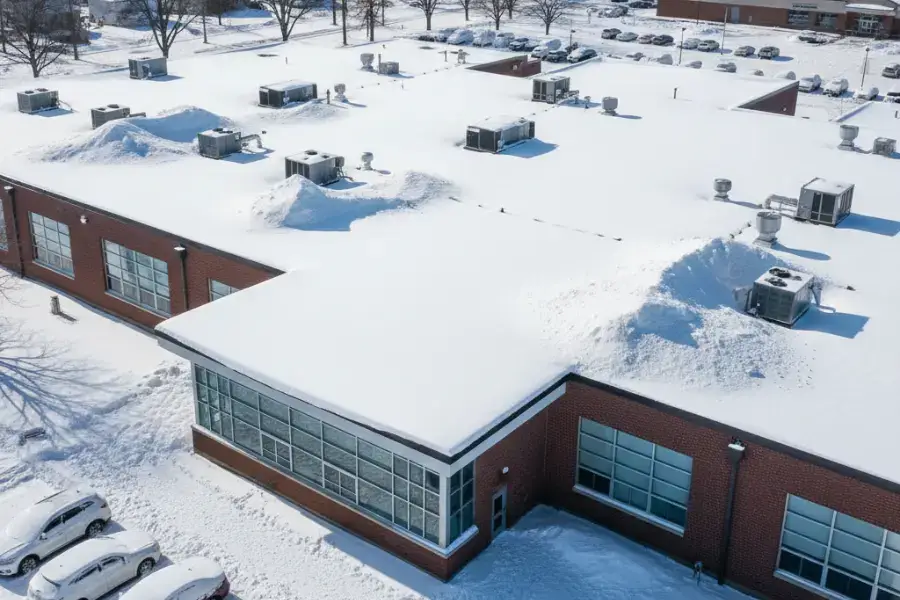
7. Snow Piled Higher in Certain Areas of the Roof
Wind can push snow into certain parts of the roof, causing uneven build-up.
What you might notice (from safe locations only):
- Snow is visibly piled higher near the rooftop equipment
- Snow collecting along the roof edges or walls
- Large icicles are forming below those areas
- The same spots are causing issues every winter
These areas often carry much more weight than the rest of the roof.
What Not to Do
❗ Do not access the roof without professional clearance
❗ Do not attempt to shovel or chip ice yourself
❗ Do not allow general snow removal contractors onto the roof
❗ Do not ignore small leaks or assume they will resolve on their own

How To Remove Snow From Flat Roofs
Commercial snow removal is a controlled roofing operation – not general snow clearing. Here’s what property managers should expect when working with professionals:
1. Pre-Removal Assessment
Before any snow is touched, we take time to understand the roof itself. The roofing contractor reviews roof plans, identifies drainage locations, rooftop equipment, and known weak points.
If there is any concern that the snow load could be approaching structural limits, a structural engineer may be consulted before removal begins. This ensures snow is removed in a way that relieves stress rather than shifting it to another part of the roof.
2. Safety Planning
The crew establishes safe access points to the roof and sets up fall protection systems in accordance with Ontario Working at Heights requirements. Safe locations for snow disposal are identified in advance so that snow can be moved off the roof without creating hazards at ground level.
3. Priority Snow Relief
Snow is not removed all at once or evenly across the roof. Instead, professionals focus first on areas that pose the greatest risk.
These typically include:
- Roof drains and drainage paths, so that melting snow can escape
- Areas where wind has caused deeper snow buildup
- Around rooftop equipment, where snow can trap water or add extra weight
- Low spots in the roof where water and snow naturally collect
By relieving pressure in these areas first, the overall load on the roof is reduced more safely and effectively.
4. Controlled Snow Removal
Once priority areas are addressed, the remaining snow is removed in a controlled manner. Roofing professionals use tools and techniques designed to protect the roof membrane, avoiding sharp or heavy equipment that could tear or puncture the surface.
Snow is removed gradually and evenly to prevent sudden load shifts. Importantly, snow is never piled or stored on the roof, even temporarily, as this can create new stress points.
5. Ground-Level Snow Management
As snow is removed from the roof, it must be placed somewhere safe at ground level. Our contractors ensure snow is deposited away from:
- Building entrances and exits
- Emergency access routes
- Fire lanes and loading areas
- Pedestrian walkways
On large sites or in dense urban areas, snow may need to be transported off-site to prevent congestion or safety issues around the building.
6. Post-Removal Inspection
Once snow removal is complete, the roof is inspected to confirm that:
- Drainage is functioning properly
- No damage occurred during removal
- Previously hidden issues are identified early
If any vulnerabilities or minor damage are discovered, they can be addressed immediately – helping prevent leaks or emergency repairs later in the winter.
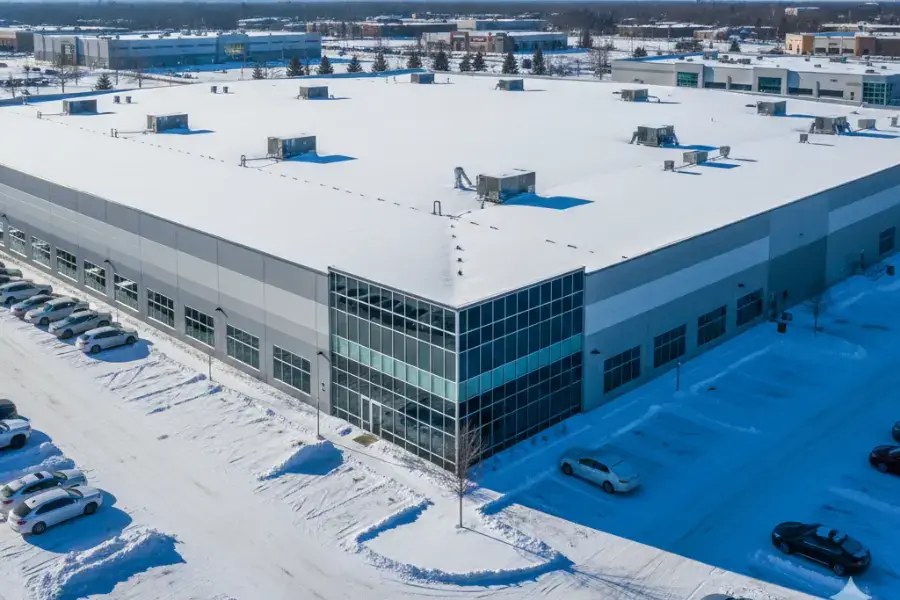
Why Choose a Professional Roofer for Snow Removal?
Snow removal on a commercial flat roof isn’t a routine maintenance task – it’s a specialized roofing service that directly affects the safety, performance, and lifespan of your roof system.
Professional commercial roofers understand that removing snow incorrectly can cause as much damage as leaving it in place. That’s why trained roofing crews follow controlled methods that reduce weight without compromising the roof itself.
Experienced roofing professionals:
- Are Working at Heights certified, ensuring safe access and fall protection
- Understand how snow weight is distributed across a flat roof
- Know how to clear snow without damaging membranes, seams, or flashing
- Use tools and techniques designed specifically for roofing surfaces
- Recognize early warning signs of structural stress or membrane failure
- Carry proper commercial insurance and liability coverage
At Industrial Roofing Services Limited, snow removal is approached as part of a broader roof protection strategy – not a quick clear-off. With over 45 years of experience working on commercial and industrial flat roofs across Toronto, the GTA, and Southern Ontario, our team understands how winter conditions impact different roofing systems.
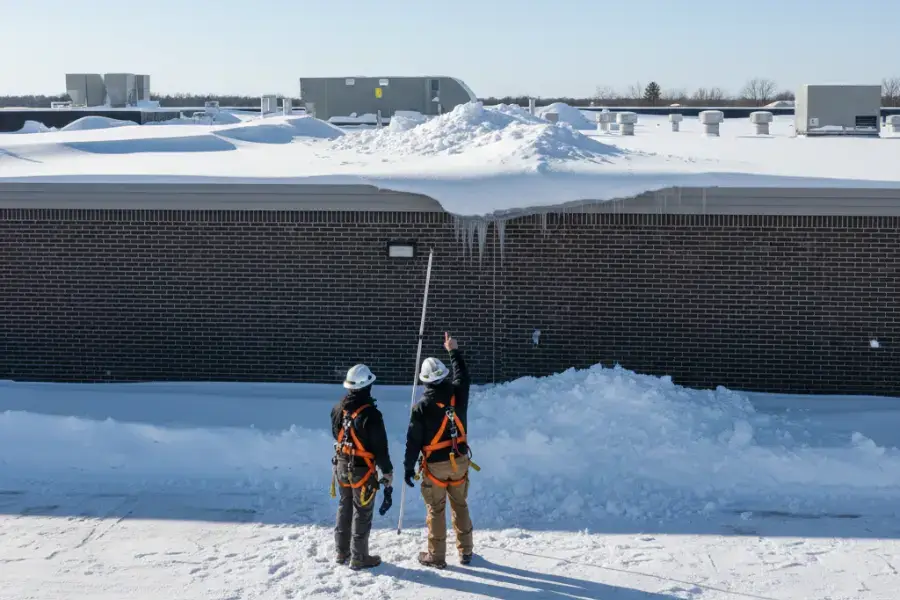
What Does “Flat Roof Snow Load” Mean?
Snow load refers to the temporary (live) weight imposed by snow and ice on a roof structure. Unlike permanent loads, snow load changes constantly due to:
- Snowfall amount and density
- Wind drifting
- Roof geometry
- Building heat loss
- Melting and refreezing
Snow load capacity is defined during building design and documented in construction drawings. When records are unavailable, structural engineers can calculate safe load thresholds.
Importantly, snow does not distribute evenly – drifting often concentrates weight near parapets, rooftop equipment, and transitions.
How Much Does Snow Weigh?
Snow weight varies significantly depending on moisture content:
- Light, dry snow: ~7-10 lbs per cubic foot
- Wet, compacted snow: up to 30 lbs per cubic foot
Rain, partial melting, and refreezing can dramatically increase weight — even when snow depth appears reduced. Ice weighs the same as water, but occupies less space, further increasing load concentration.
Ground snow depth does not reliably indicate rooftop snow load – roof conditions must be assessed directly.
How Often Do Roofs Collapse from Snow Weight?
Complete roof collapse from snow alone is rare, particularly on modern, well-maintained buildings. However, risk increases due to:
- Aging roof systems
- Poor drainage
- Deferred maintenance
- Structural modifications
- Prolonged or extreme winter conditions
More commonly, excessive snow causes structural deflection, which can damage:
- Sprinkler systems
- Mechanical lines
- Electrical conduits
- Interior finishes
These issues can be just as costly – and disruptive – as structural failure.

How To Plan for Winter Roof Safety
Snow removal is most effective when it’s part of a proactive winter roof management strategy, including:
- Pre-winter roof inspections
- Flat Roof drainage maintenance
- Defined snow-removal thresholds
- Emergency response planning
Industrial Roofing Services Limited works with property managers, facility teams, and engineers across Toronto, the GTA, and Southern Ontario to manage winter risks safely and professionally.
If snow accumulation on your commercial flat roof is a concern – or if you want to be prepared before the next storm – our team is ready to help.
Protect your roof. Reduce risk. Stay operational all winter.