


In this article
Flat roof blisters are the raised bubbles you see pushing up through the surface of a low-slope roof. Each one is a pocket where the membrane has lifted away from the layer beneath it, trapping air or moisture inside. Some sit quietly for years. Others are the first sign of a problem that will open the roof up to water, which is why it pays to know which is which before you decide to act. If a blister has you concerned, the safest first move is to have the roof looked at by a commercial roofer.
The short version: a blister on its own is not an emergency, but it is a symptom. Understanding what formed it tells you whether you are watching a cosmetic quirk or the early stage of a leak.
What a flat roof blister actually is
A flat roof is built in layers: a deck, insulation, and a waterproof membrane bonded on top. A blister forms when two of those layers lose their grip on each other and a void opens between them. Whatever is in that void, air, water vapour, or both, expands when the roof heats up and contracts when it cools. Over many cycles the trapped pocket stretches the membrane upward into the familiar dome.
The key detail is where the separation sits. A blister between plies inside the membrane behaves very differently from one sitting between the membrane and the insulation below it. The deeper the separation, the more of the roof system it can affect, and the more attention it deserves.
Did you know?
A blister can grow and shrink visibly over a single day. Roofers often inspect in the morning when the roof is cool and the blisters are flattest, then again in the afternoon heat when trapped air has expanded and the same spots dome up. The difference tells them how much pressure is building underneath.
Main causes of blistering
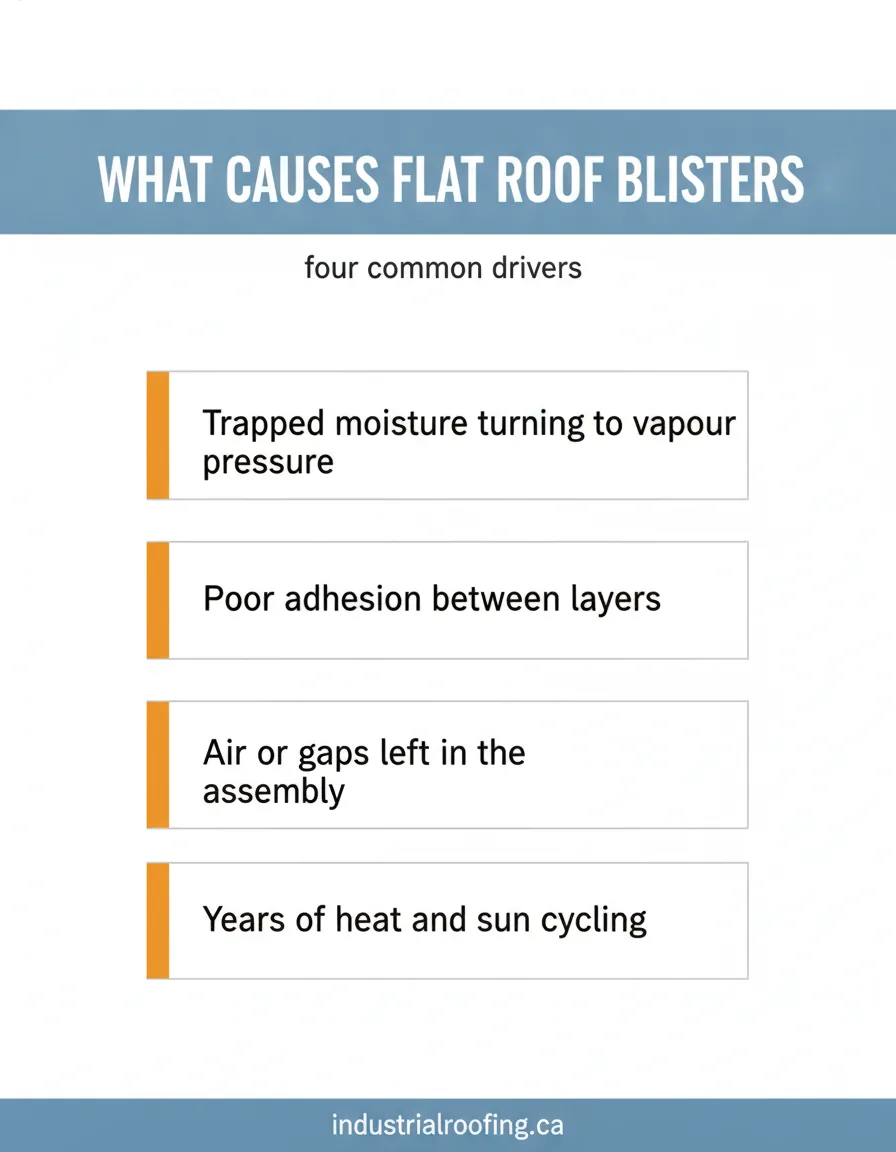
Blisters rarely have a single cause. Most trace back to one of these, and often a combination:
- Trapped moisture. Water that got into the assembly during installation, through a leak, or as vapour from inside the building turns to vapour pressure when the sun heats the roof, and that pressure lifts the membrane.
- Poor adhesion. If a layer was bonded over a dusty, damp, or cold surface, the bond is weak from day one. Heat cycling then finishes the job of pulling it apart.
- Solvent or air left in the assembly. On built-up and modified bitumen roofs, gaps in the bitumen or pockets of air between plies become blisters once the roof starts to breathe with the temperature.
- Heat and sun cycling. Even a sound roof expands and contracts daily. A small weak spot becomes a blister over years of that movement, which is why older roofs show more of them.
Because moisture is so often involved, blistering tends to cluster where water collects or where the original installation was rushed. The Canadian Roofing Contractors Association publishes guidance on low-slope membrane performance through its national roofing standards and resources, and the recurring theme is that surface prep and dry conditions during install prevent most of these problems.
Pro tip
Never cut a blister open to see what is inside. Slicing it turns a sealed pocket into an open hole and gives water a direct route into the roof assembly. If a blister needs to be investigated, that is a job for a roofer who can patch it properly in the same visit.
When a blister is serious
Here is the line that matters. A blister that is intact, dry, and stable is usually monitored rather than rushed into repair. A blister that has ruptured, sits in a pond of water, or is spreading is a different story, because the membrane is no longer doing its one job.
Watch for a few warning signs: a blister that has worn through at the top, has soft or spongy areas around it, shows staining on the ceiling below, or is sitting on a membrane seam threatening to split. Any of those means water is either getting in already or about to. A single small dome in the middle of an otherwise sound field is far less urgent than a ruptured one next to a drain.
Catching the difference is exactly what a trained eye is for. A close look across the whole roof, not just the obvious blister, is the only way to know whether the rest of the field is sound.

What to do about a blistered roof
Your response depends on what the blister is telling you, and a qualified roofer is the one to make that call. In broad strokes:
- Leave intact blisters alone. If it is sealed and dry, the membrane is still keeping water out. Note where it is and keep an eye on it.
- Document changes. Photograph blisters and their locations so you can tell whether they are spreading between visits. Pattern matters more than any single bubble.
- Act on ruptured or wet blisters. These get cut out and patched, or in a cluster, the section gets rebuilt. The goal is to restore an unbroken waterproof layer.
- Address the cause, not just the dome. If trapped moisture or standing water is feeding the blistering, fixing drainage and ventilation is what stops new ones from forming.
Standing water deserves special mention, because a roof that drains poorly will keep producing blisters no matter how many you patch. If your roof holds water 48 hours after a rain, that underlying slope problem is worth solving first, and our guide on getting water off a low-slope roof faster explains the options. Where the slope itself is the issue, our team often builds the correct fall back into the roof during a re-cover.
Download the free quick guide
Save this as a PDF to keep on hand.
Flat Roof Blister Quick Guide (PDF)Frequently asked questions
Are flat roof blisters always a sign of a leak?
No. Many blisters are sealed pockets of trapped air or vapour that have not broken through the membrane, so the roof is still keeping water out. The concern is what happens over time, because every blister is a weak point that heat and foot traffic can eventually rupture. An intact, dry blister is usually monitored, while one that has split open or sits in standing water needs attention. The only reliable way to tell which you have is a proper look at the whole roof, not just the bubble.
Can I just pop or cut a blister myself?
It is strongly discouraged. Cutting a blister turns a sealed void into an open wound in your waterproof layer and invites water straight into the assembly, often making a minor issue into an active leak. Blisters also tend to be a symptom of a deeper cause like trapped moisture or poor adhesion, so removing the dome without addressing that cause solves nothing. Proper repair means cutting out the affected area and rebuilding the membrane so it is continuous again, which is work for a commercial roofer.
Why do blisters appear more on older roofs?
Every flat roof expands in the heat and contracts as it cools, and that daily movement works on any weak bond in the assembly. On a new, well-installed roof those weak spots are rare. On an older roof, years of thermal cycling have had time to find every marginal bond, every pocket of trapped air, and every spot where moisture worked in. The result is more blisters as a roof ages, which is one reason regular inspection becomes more valuable the older a roof gets.
Will fixing drainage stop blisters from coming back?
Often, yes, when standing water is the driver. Water that ponds on a roof keeps feeding moisture into the assembly and into vapour pressure under the membrane, so blisters return no matter how many you patch. Correcting the slope so the roof sheds water, whether by improving the existing drainage or building in proper fall, removes that source. It will not undo damage that is already there, but it stops the cycle that creates new blisters and protects the repairs you do make.
What to do next
Note where the blisters are, leave the intact ones alone, and watch for any that rupture or sit in water. If a roof is blistering across the field or near drains, have it evaluated before the next freeze-thaw season. Industrial Roofing Services works on commercial and industrial flat roofs across Ontario.

Written by
Devon M.
Building Envelope & Roof Asset Specialist
Devon specializes in industrial building science and commercial roof assemblies in Ontario. He focuses on the technical requirements of roof condition surveys, infrared moisture scanning, and life-cycle cost analysis to assist property managers with long-term asset management.