

If you own or manage a flat-roofed commercial building in the GTA and you are looking at a re-roof in the next year or two, you have probably already been told you need a single-ply membrane. The next question is which one? TPO, EPDM, or PVC. Every roofer in Toronto has a favourite, every manufacturer claims theirs is best, and the price spread between the three can be 20 to 40 percent on the same building. Here is the honest comparison from us, who used all three across hundreds of GTA warehouses. If you want a commercial roofing service in the GTA that actually compares apples to apples, this is the framework to use.
The Quick Answer
Most GTA commercial buildings under 100,000 square feet end up with TPO. It is the cheapest of the three, welds clean, and the warranty options are now competitive with PVC. EPDM still wins on a few specific buildings (cold-only environments, simple geometry, owners who plan to hold the building 20+ years and do not mind a black roof). PVC wins where there are rooftop chemical exhausts, kitchen grease vents, or rooftop solar panels going in. It may seem simple, but there’s more to this than you think.
What Each Membrane Actually is
TPO (thermoplastic polyolefin)
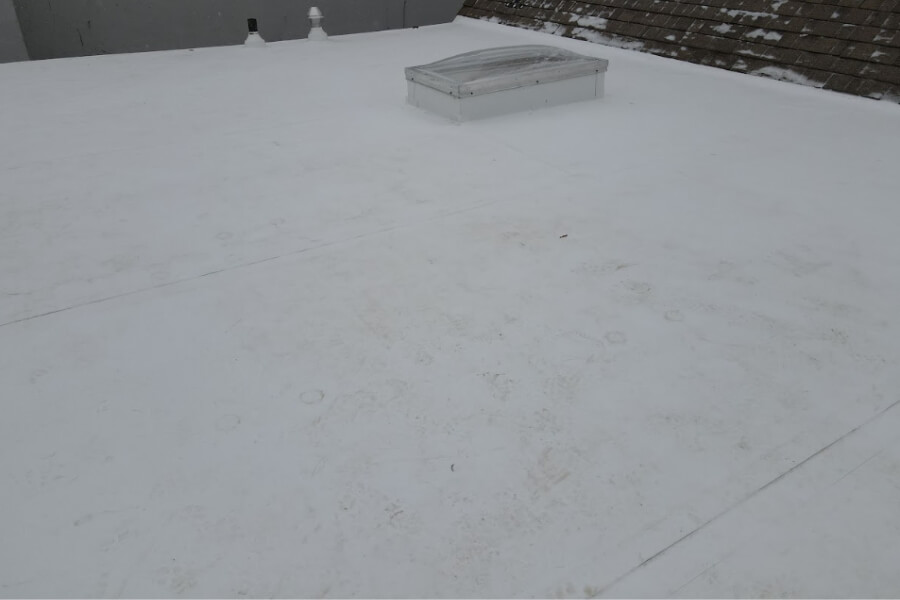
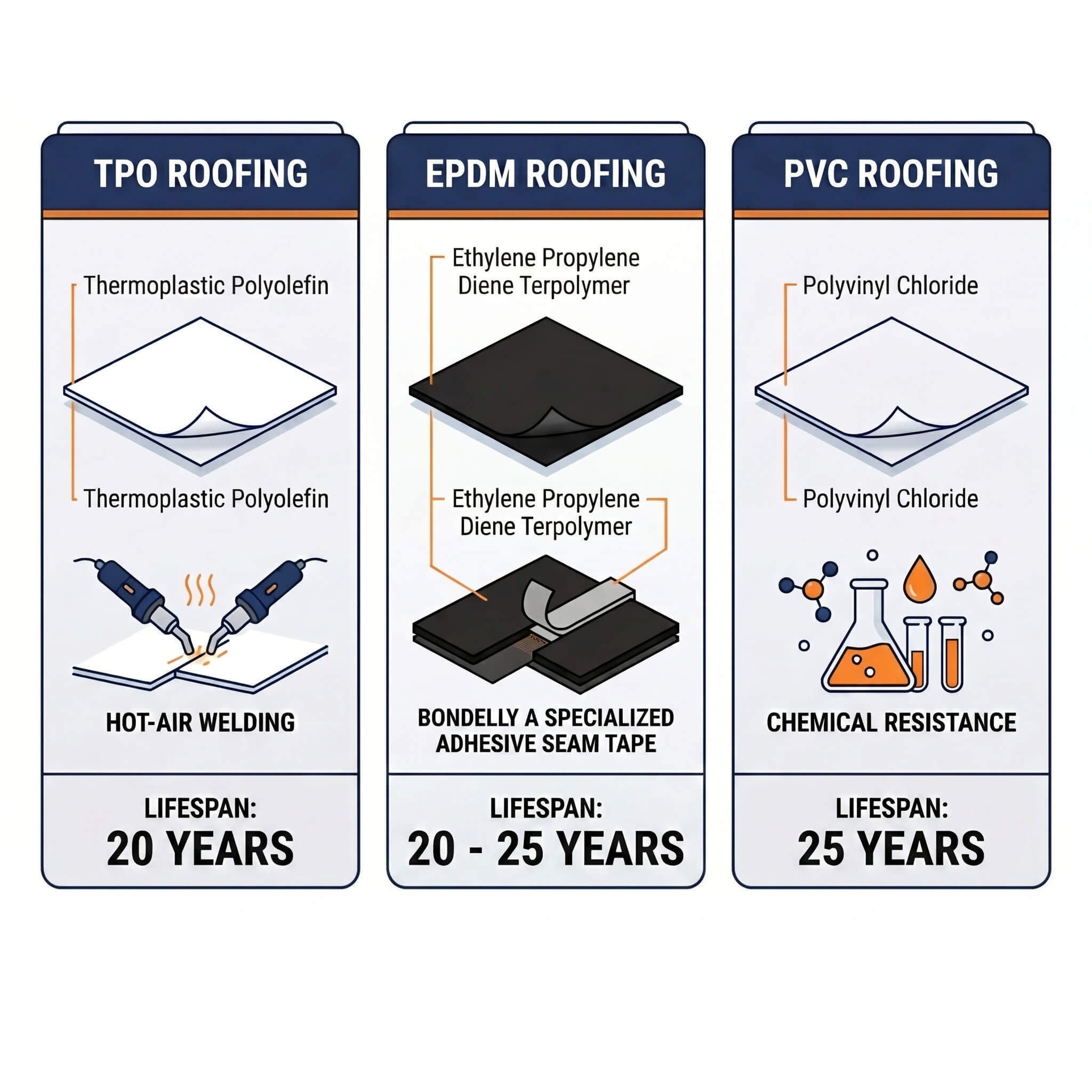
A blend of polypropylene and ethylene-propylene rubber, reinforced with a polyester scrim. Comes off the roll white (the most common colour in the GTA), grey, or tan. Sheets are seamed with hot-air welding which creates a chemical fusion stronger than the membrane itself. Average installed thickness is 60 mil for commercial work, 80 mil where the warranty calls for it.
EPDM (ethylene propylene diene monomer)
A synthetic rubber, almost always black, sometimes white-coated. The original “rubber roof” that took over the North American flat roof market in the 1980s. Sheets are seamed with adhesive tape and primer rather than heat-welded. Standard thickness is 60 mil, with 90 mil available where impact resistance matters.
PVC (polyvinyl chloride)
A thermoplastic membrane reinforced with polyester or fibreglass. White or grey on most GTA installs. Hot-air welded like TPO. Standard thickness 50 to 80 mil. PVC was the original single-ply heat-welded membrane, and it is still the gold standard for chemical and grease resistance.
Lifespan and Warranty
All three membranes carry 20 to 25 year manufacturer warranties when installed by a certified contractor. Based on our team’s experience, this is what we found for real world cases.
- EPDM: 20 – 25 years years on a well-maintained roof. The longest service life of the three. Black EPDM gets brittle after about 25 years but rarely fails catastrophically.
- PVC: 25 years. The plasticizers in older PVC formulations migrated out of the membrane and caused shrinkage at corners. Modern PVC formulations have largely solved this.
- TPO: 20 years on the newer formulations (post-2010). Earlier TPO had real durability problems and a deserved bad reputation. The current generation is significantly improved.
Chemical and Grease Resistance
This is the single biggest reason to pick PVC over TPO. Animal fats, kitchen grease, jet fuel, and many industrial solvents will degrade TPO and EPDM but have almost no effect on PVC. If your building has rooftop kitchen exhausts, food processing, or chemical exhaust stacks, the membrane around those penetrations needs to be PVC even if the rest of the roof is TPO. Most roofers will install PVC walk pads and curb wraps in those zones as a hybrid solution.
Energy Performance and Cool Roofs
White TPO and white PVC reflect 75 to 85 percent of incoming solar radiation. Black EPDM reflects under 10 percent. On a hot Toronto July afternoon, a black EPDM roof can run 70 to 80 degrees Celsius on the surface while a white TPO next door runs 35 to 40 degrees. That heat transfers through the deck into the building and into the HVAC load. For air-conditioned warehouses and distribution centres, the cooling savings on a white roof typically pay for the membrane upgrade within 8 to 12 years. White-coated EPDM exists but commands a premium that erases the cost advantage.
Wind Uplift and Storm Performance
All three membranes can pass FM Global wind uplift testing for the GTA wind zone. The difference is in the installation method. Mechanically attached single-ply (TPO and PVC) handles wind uplift through fastener spacing engineered to the deck and the building height. Fully adhered systems use bonding adhesives. Ballasted EPDM relies on the ballast weight, which is the reason many newer GTA buildings cannot use it. After the major windstorms of 2018 and 2022 in Southern Ontario, several improperly designed ballasted roofs lost ballast over the parapet, exposing the membrane to point loads.
Welding and Seam Reliability
This is where TPO and PVC have a real advantage over EPDM. A hot-air weld at 540 degrees Celsius fuses two sheets into a single piece of plastic. The seam is stronger than the membrane itself, and a proper welder can probe-test every seam before leaving the roof. EPDM seams use seam tape with primer. The tape is reliable when installed correctly, but adhesive seams are slower to inspect, and any contamination during application creates a weak point. Over 25 years on a roof, the most common EPDM failure mode is tape seam separation at corners and penetrations.
Which membrane to Pick
- Standard GTA warehouse, distribution centre, big box retail: TPO. Best price, best welding, current formulations are reliable, white reflects heat. Pick a tier-one manufacturer and install at 60 mil minimum.
- Long-hold owner, simple roof, no rooftop equipment, comfortable with black: EPDM. Longest service life, lowest maintenance over the holding period, and the simplest field-installed system in the trade.
- Restaurant, food processing, industrial chemical exhaust, rooftop solar: PVC. The chemical resistance and weldability are worth the premium, and PVC is the only membrane some solar manufacturers will warrant against.
- Cold storage warehouse: Either TPO or PVC, fully adhered, with vapour control on the warm side of the insulation. EPDM is harder to detail at the cold-side penetrations.
Good Installation vs a Bad One
Membrane choice matters less than installation quality. The same TPO that lasts 20 years on a careful install will fail in 8 years on a sloppy one. Look for:
- Manufacturer certification of the installing contractor (not just the company, the foreman on your job).
- Proper insulation board layout with staggered joints and full coverage adhesive or fastener pattern.
- Detailed flashing at every penetration, parapet, and equipment curb. Field welds at corners, not patched membrane.
Final Thoughts
Every GTA commercial building has a single membrane that is the right answer when you weigh cost, lifespan, energy savings, and the equipment on the roof. Industrial Roofing Services Limited has installed all three systems across Southern Ontario since 1973, and we will give you a comparison quote across TPO, EPDM, and PVC for the same scope before you commit. request a free quote and we will walk through your roof, and put real numbers against each option.
Frequently Asked Questions
Is white TPO required by Toronto Green Standard?
Toronto Green Standard requires a minimum solar reflectance index (SRI) on roofs for new construction and major retrofits in many zones. White TPO and white PVC meet the requirement. Black EPDM does not. White-coated EPDM does. Check with your designer for your specific building tier under the standard.
How thick should my membrane be?
60 mil is the standard for commercial work in the GTA. 80 mil is recommended for high-traffic roofs (frequent maintenance access), high-hail-risk locations, or any building where a 30-year warranty is on the table. The cost increase from 60 to 80 mil is usually 15 to 20 percent and is almost always worth it on a building you plan to hold for two decades.
What about ballasted EPDM over insulation?
Older buildings with deck capacity for ballast can still use it. New steel decks rarely have the structural margin. Always have the structural engineer sign off on dead load before specifying ballast on any post-1990 building.
Do single-ply roofs need maintenance?
Yes. Twice-yearly inspections, drain cleaning, and seam checks at penetrations are standard. A maintained roof routinely outlasts its warranty. An ignored roof routinely fails inside the warranty period and the manufacturer voids the claim because of the lack of maintenance records.

Written by