

Why does an EPDM roof that looked fine for years suddenly show a gap at the seams? In most cases, the membrane itself did not fail. It moved, slowly and unevenly, and the seam was the joint that had nowhere else to go. EPDM roof shrinkage is a normal characteristic of the material, not a manufacturing defect, but left unmonitored it is one of the more common reasons a single-ply membrane starts to leak at the seams rather than in the field of the roof. If a walk of your building’s roof has turned up separation like this, our EPDM roofing team can take a closer look and tell you what you are actually dealing with.
What EPDM shrinkage actually is
EPDM membrane is manufactured in large rolls, calendared and cured under tension, then wound onto a core for shipping. Once it is unrolled and installed flat on a roof, the sheet gradually relaxes back toward its original, unstretched dimensions. That relaxation is shrinkage, and manufacturing standards for the material allow for a small amount of it in any direction as a normal characteristic of how the sheet is produced, not a sign that a specific roof was installed badly.
The catch is that shrinkage does not happen instantly and it does not happen evenly across a roof. A membrane anchored at the perimeter and around penetrations experiences more restraint in some areas than others, so the sheet pulls unevenly rather than contracting like a single uniform block. That uneven pull is what eventually shows up as bridging, tenting, or separation at the weakest points, which are almost always the seams.
Good to know
This article is general information, not professional advice. Roof conditions, flashing details, and manufacturer requirements vary by building and product, and they change over time. Confirm the specifics that apply to your roof with a qualified roofing contractor before you make a decision. Industrial Roofing Services Limited is not responsible for decisions made solely on the basis of this article.
How shrinkage leads to seam separation
A seam is where two membrane panels overlap and get bonded together with tape or adhesive. That bond is only as strong as its weakest link on the day it was made, and shrinkage puts continuous, low-level stress on that bond for years afterward. If the seam was made with the manufacturer’s specified system and cured properly, it can absorb a lot of that stress. If the seam was rushed, made in poor weather, or the membrane was under tension when it was seamed, shrinkage has an easier path to pull it apart over time.
Temperature plays a role too. A membrane seamed while hot will contract as it cools overnight, and that contraction can work against an adhesive bond that has not fully cured yet. According to the EPDM Roofing Association’s technical bulletin on membrane dimensional stability, this combination of shrinkage and seam bond strength is one of the standard variables the industry tracks when evaluating why single-ply seams underperform relative to the field membrane.
Did you know
The industry allowance for EPDM dimensional shrinkage is a normal part of how the material is manufactured and installed, not evidence of a defective roof. What separates a stable roof from a problem roof is usually how the seams were detailed and maintained, not the shrinkage itself.
Which roofs are most exposed to it
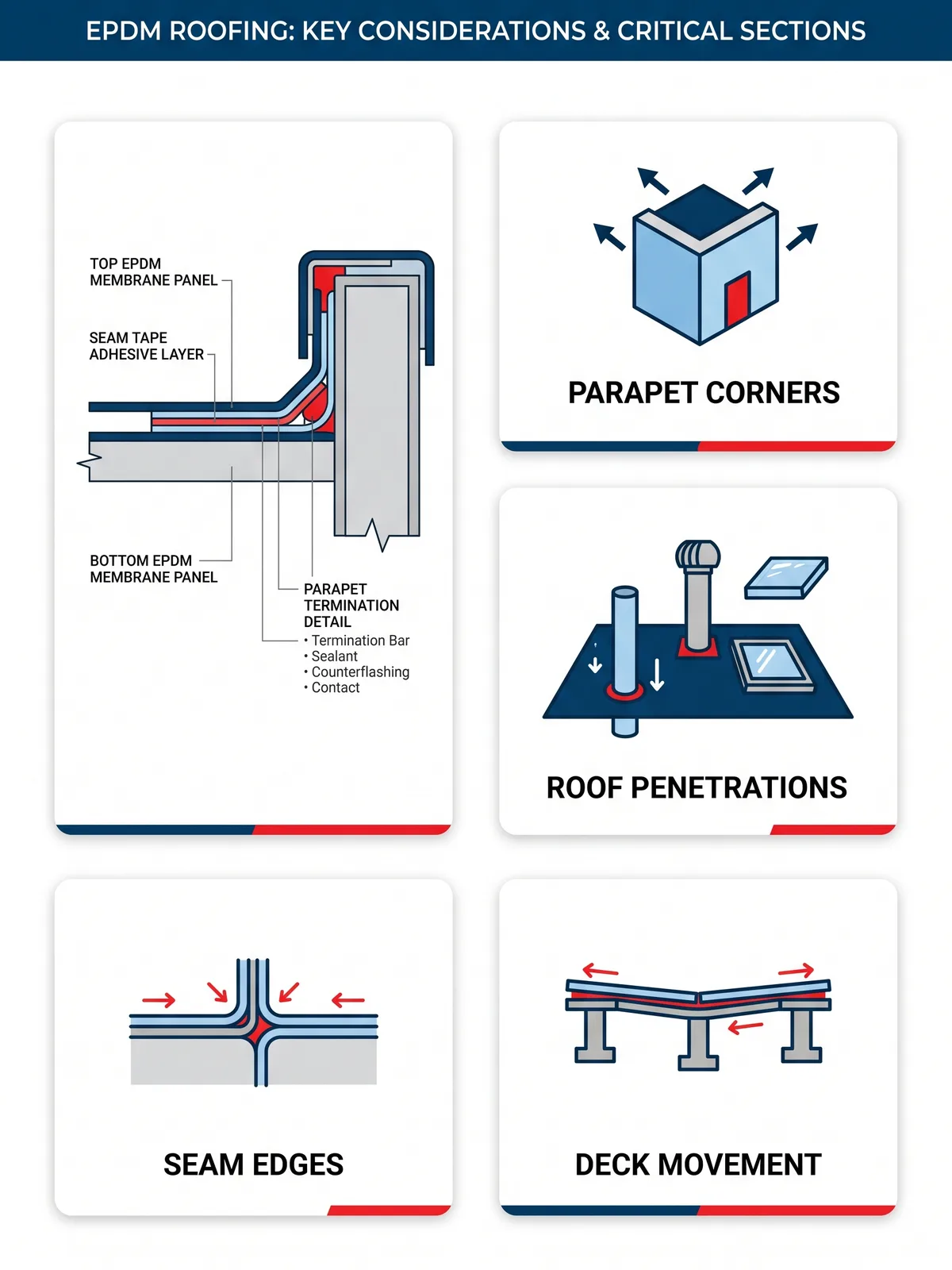
Fully adhered EPDM systems generally handle shrinkage-related stress differently than mechanically fastened ones, since the adhesive bonds the membrane to the substrate across its whole surface rather than at fastener rows. Roofs with a lot of penetrations, curbs, and parapet detail have more seam length and more restraint points relative to their overall size, which tends to concentrate stress at those joints.
Age matters as well, though not in a fixed or predictable way. Roofs that see wide daily and seasonal temperature swings put their seams through more expansion and contraction cycles per year than a climate-stable environment would, and older adhesive systems on a roof do not necessarily perform the same as newer tape-based seaming systems.
Where separation tends to show up first
Corners and parapet terminations are usually the first place to check, since the membrane changes direction there and has the least room to move without stressing a seam. Penetrations, drains, curbs, and mechanical equipment bases are a close second, for the same reason: any point where the membrane is fixed in place is a point where shrinkage elsewhere on the roof has to be absorbed somewhere nearby.
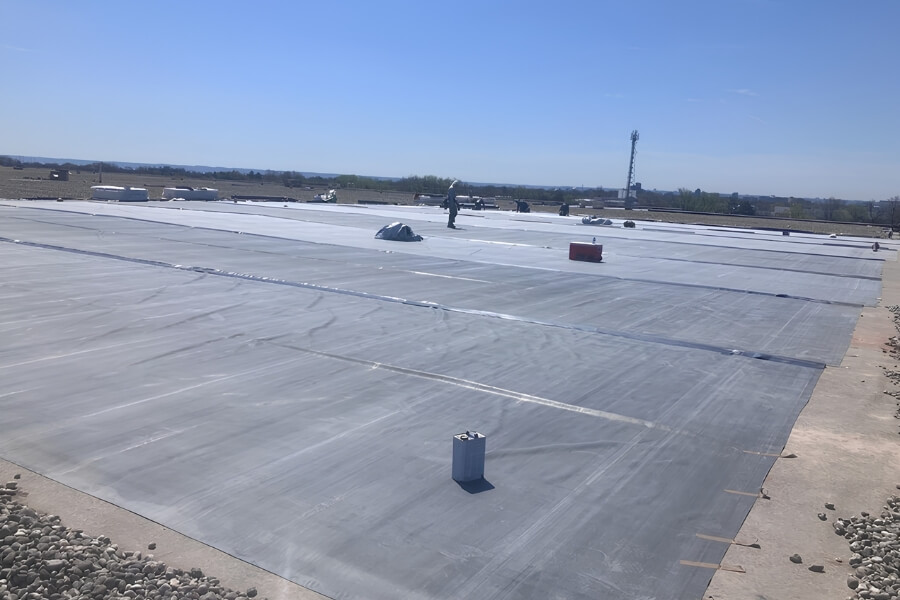
Field seams, the long runs where two membrane panels meet across an open area of roof, tend to separate later and less often, but they are not immune, especially on older installations or in a seam that was made in marginal weather conditions at the time.
People often ask
Does a small seam gap mean the roof is leaking right now? Not necessarily. A visible gap means that joint is under stress and worth documenting and monitoring closely. Whether it is actively letting water through depends on the specific detail, the slope at that location, and how long the gap has been open.
What a seam inspection actually checks
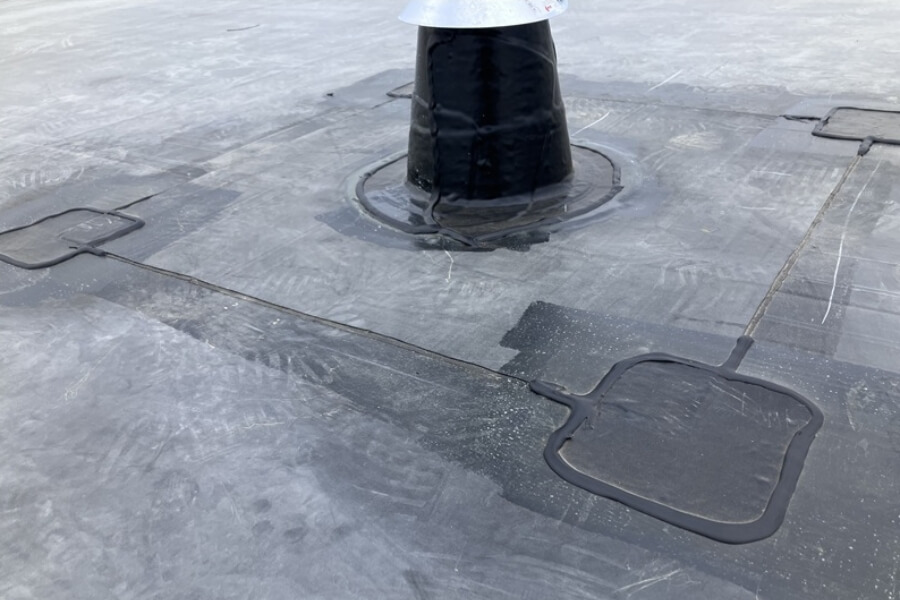
A proper seam inspection is a slow, deliberate walk of every seam line, not a glance from the roof hatch. An inspector is looking for lifting or tenting at the tape edge, visible gaps where the two membrane panels no longer overlap cleanly, and any bridging where the membrane spans a low spot instead of following the roof deck underneath it. Corners, penetrations, and parapet terminations get checked first, for the reasons above.
Where a previous repair exists, the inspection also confirms that patch is still adhered flush to the surrounding membrane rather than lifting at its own edges, since a poorly integrated repair can become its own future separation point.
How shrinkage interacts with other roof problems
Shrinkage rarely causes a leak entirely on its own. It is more often the mechanism that turns a small, otherwise minor issue, ponding water near a corner, a clogged drain holding water against a parapet, foot traffic near a curb, into an active leak point, by keeping stress concentrated exactly where the membrane can least afford it. That is part of why seam condition and drainage condition tend to get reviewed together when your roof gets assessed, rather than as separate items.
What to do if you find separation
Document what you see with photos and a date before doing anything else. A small, isolated gap that is caught early is often a localized repair. The same gap, left through another freeze thaw cycle or two, has a way of growing and drawing in nearby seams and details that were previously fine.
From there, the right move is a professional evaluation rather than a DIY patch. A roofing contractor can confirm whether the seam system matches the membrane manufacturer’s specification, whether the separation is isolated or part of a wider pattern across the roof, and whether a targeted repair or a broader seam re-cover makes more sense for your building.
Free download
Download the EPDM Seam Inspection Checklist (PDF)Frequently asked questions
Is EPDM shrinkage a sign of a defective roof?
Not on its own. A small amount of dimensional shrinkage is a normal characteristic of how EPDM membrane is manufactured and installed, and industry standards for the material account for it. What matters more is how the seams were detailed and whether they are being monitored, since that is what determines whether shrinkage ever turns into an active leak.
How can I tell if my EPDM roof’s seams are separating?
Look for lifting or tenting where the seam tape meets the membrane, visible gaps where two panels no longer overlap cleanly, and bridging where the membrane spans a low area instead of following the deck. Corners, parapet terminations, and penetrations are the most common places to check first, since they see the most concentrated stress.
Does seam separation always mean the roof is leaking?
No. Separation means a seam is under stress and its bond is compromised, which increases the risk of a leak, but whether water is actively getting through depends on the specific location, slope, and how long the gap has been open. Any visible separation is worth documenting and having reviewed by a professional rather than assuming it is or is not currently leaking.
How often should EPDM seams be inspected?
An annual seam walk is a reasonable baseline for most commercial EPDM roofs, with an additional check after any severe weather event. Roofs with a lot of penetrations, older seam systems, or a history of previous separation may benefit from more frequent monitoring. A roofing contractor familiar with your specific roof can help set an appropriate schedule.
Can a separated seam be repaired without replacing the whole roof?
In many cases, yes. A localized, early-stage separation is often addressed with a targeted repair to the affected seam and surrounding area. Whether that is the right approach for your building depends on how widespread the separation is and the overall condition of the membrane, which is why a professional evaluation should come before deciding on a repair or a broader re-cover.
EPDM roof inspection and repair across the GTA and Southern Ontario
Industrial Roofing Services Limited inspects, maintains, and repairs EPDM membrane roofs for commercial and institutional buildings across the GTA and Southern Ontario, including crews serving Bowmanville, Ontario and Elmira, Ontario. If a seam walk has turned up separation, or it has simply been a while since anyone checked, request a free flat roof inspection and we will tell you exactly what your seams look like today.